Bead Threading
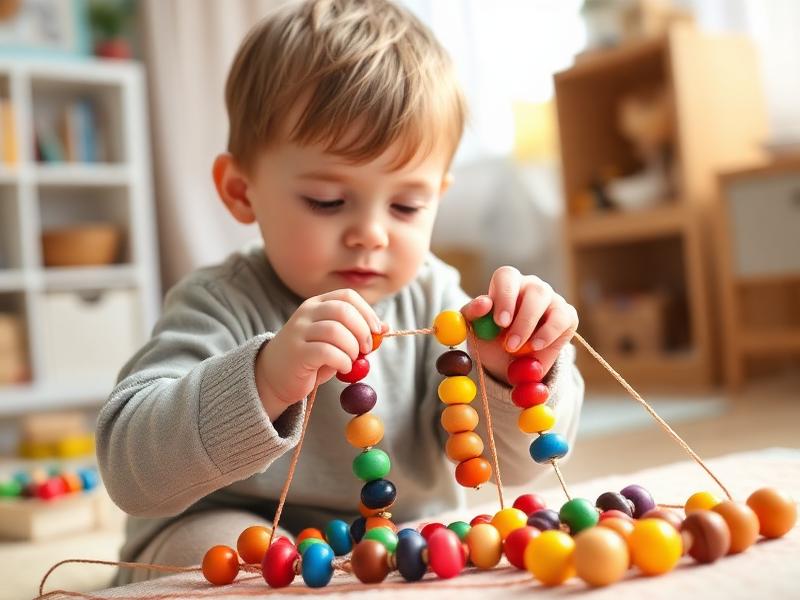
Threading beads onto string seems simple until you watch a three-year-old try it. The concentration on their face, the tongue sticking out, the triumph when a bead slides down the string—it's a whole experience. Bead threading is fine motor work at its finest: pincer grasp, hand-eye coordination, bilateral coordination, and patience all wrapped into one activity. My daughter made me a 'necklace' of chunky wooden beads when she was three, and I wore it proudly to work.
Age Safety Note
Use LARGE beads only—minimum 2 inches diameter for 3-4 year olds. Standard craft store beads are too small and are choking hazards. Even large beads require supervision; some children still mouth objects at this age. Pipe cleaners work better than string for beginners because the stiff end is easier to poke through bead holes. Store beads out of reach between sessions.
Why This Activity Works
Threading develops the pincer grasp that's essential for writing. The focus required builds attention span. Patterning beads by color or shape introduces early math concepts. And completing a bracelet or necklace provides tangible success—wearable proof of their effort. Fine motor activities like threading also tend to be calming, making this a good choice for transition times or regulation.
Materials Needed
- Large wooden beads
2+ inches diameter with large center holes. Smaller beads are choking hazards.
- Pipe cleaners or thick shoelaces
Stiff ends are easier for beginners than floppy string.
- Yarn with taped end
Wrap tape around one end to create a 'needle' if using yarn.
- Bowl or tray
To contain beads and prevent rolling.
Prep Tips (Before You Start)
- 1Start with pipe cleaners—the stiff wire is much easier than floppy string.
- 2Pour beads into a shallow bowl or tray so they don't roll away.
- 3Tie a 'stopper' bead at the end so threaded beads don't fall off.
- 4Have just 2-3 colors initially to encourage patterning.
- 5Sit at a table (not on the floor) where beads are easier to control.
Step-by-Step Guide
- 1Show the beads and string. 'Let's make a necklace! We poke the string through the beads.'
- 2Demonstrate slowly: pick up bead, find the hole, poke string through, slide bead down.
- 3Hand over the materials. Be patient—this takes practice!
- 4Offer help only when asked: 'I'm right here if you need me to help find the hole.'
- 5Encourage pattern talk: 'What color will you put next?'
- 6Tie ends together when finished to create a wearable piece.
- 7Celebrate the finished product: 'You made a necklace all by yourself!'
Fun Variations to Try
- •Thread onto stiff pipe cleaners for bracelets that hold their shape.
- •Create patterns: red-blue-red-blue or big-small-big-small.
- •Thread pasta (rigatoni or penne) instead of beads for edible necklaces.
- •Use the necklace for counting practice: 'How many blue beads did you use?'
Cleanup Tips
- Count beads before and after—they roll under furniture easily.
- Store beads in a sealed container out of reach of younger siblings.
- Pipe cleaners and shoelaces can be reused many times.
- Roll up finished bead strings and store with beads for repeat play.
Real Parent Story
"Lucas has always been an active kid—running, jumping, never sitting still. Fine motor activities seemed impossible for him. He'd try for thirty seconds, get frustrated, and run off. I'd basically given up on crafts with him. Then his occupational therapist suggested bead threading for hand strength. I was skeptical, but we tried it with oversized wooden beads and stiff pipe cleaners. Something clicked. Maybe it was the repetitive motion. Maybe it was the clear goal—make a necklace. Maybe it was the tactile satisfaction of beads clicking together. Whatever it was, Lucas sat and threaded beads for fifteen minutes. FIFTEEN MINUTES. He made a bracelet for his teacher, a necklace for me, and something he called 'a worm' for himself. Now we bead thread weekly. It's become his calm-down activity. When he's overstimulated, I offer beads, and he settles into focused work. The kid who couldn't sit still found an anchor. Beads are his meditation."
— Mei, mom of 4-year-old Lucas
Bonus Tips From Parents
- Pipe cleaners are easier for beginners; graduate to string once skills develop.
- Very large beads are easier—start big and reduce size as skills grow.
- Some beads have directional holes (cone-shaped); show how to orient them.
- Making gifts for others (grandma, teacher) adds motivation.
References & Further Reading
General guidance we rely on when writing activities. These are broad resources rather than sources for this specific craft.
Toddler Ages & Stages
American Academy of Pediatrics
What to expect physically, socially and cognitively from 1 to 3 years.
The Power of Play
American Academy of Pediatrics
Why unstructured, hands-on play matters more than structured lessons at this age.
Choking Prevention
American Academy of Pediatrics
How to judge whether an object is a choking risk, and what to do if it happens.
Art Material Safety & the AP Seal
Art & Creative Materials Institute
Look up which craft supplies are certified non-toxic for children.
Toddler Play & Learning
Raising Children Network
Evidence-based play ideas grouped by developmental skill.
Poison Control
America's Poison Centers
Free 24/7 guidance if your child swallows something they shouldn't.
Ready for more fun?