Bean Scoop & Pour
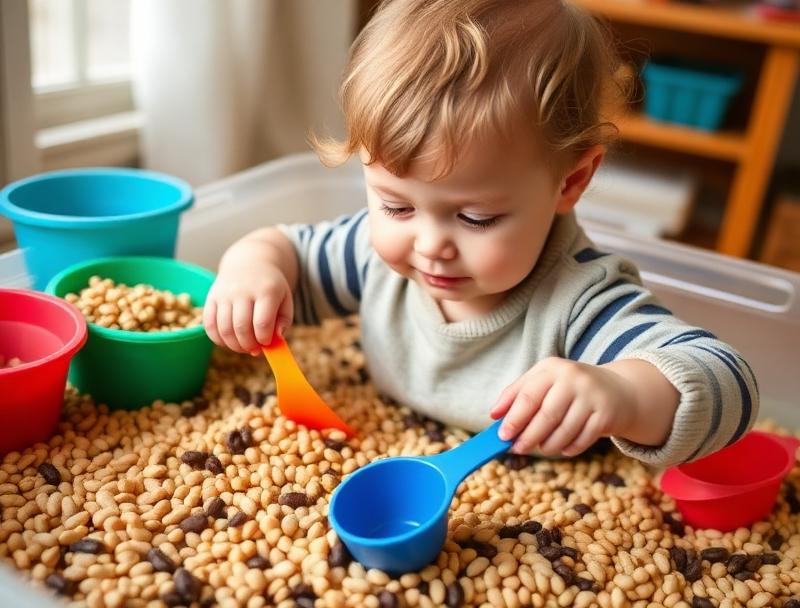
The rhythmic sound of dried beans pouring from cup to cup is hypnotic for babies. Scoop, pour, listen. Scoop, pour, listen. My daughter would do this for twenty minutes straight, transferring beans from container to container with total concentration. Bean play is sensory exploration at its simplest: just dried beans, cups, and the satisfaction of moving material from one place to another. The skills developed—scooping, pouring, fine motor control—are foundational. And the beans themselves are endlessly fascinating to little hands.
Age Safety Note
LARGE dried beans only—butter beans, large lima beans, fava beans. Standard kidney beans or smaller legumes are choking hazards. Even with large beans, constant supervision is essential; babies may still attempt to eat them. Consider this activity for older toddlers (18+ months) who no longer mouth everything. Use a shallow bin with sides to contain spills. Sweep up stray beans immediately—they're slippery underfoot and can attract pests if left on floors.
Why This Activity Works
Scooping and pouring develop the fine motor control that will later help with self-feeding and writing. The texture of dried beans provides unique tactile stimulation—cool, smooth, and clickety-clacky. Filling and emptying containers teaches early math concepts: full, empty, more, less. The repetitive nature of scoop-pour-repeat is calming and focusing. And the natural material connects babies to real-world substances rather than synthetic plastic.
Materials Needed
- Large dried beans
Butter beans, lima beans, or large white beans. Nothing smaller than a quarter.
- Shallow bin
Under-bed storage boxes work well. Sides contain spills.
- Cups and containers
Various sizes for scooping and pouring practice.
- Spoons and scoops
Different sizes challenge different skill levels.
- Funnel
Adds complexity for older toddlers.
Prep Tips (Before You Start)
- 1Pour beans into the bin—enough to fill cups but not so many that spills are overwhelming.
- 2Place the bin on a tablecloth or sheet for easy cleanup of escaping beans.
- 3Provide 3-4 different sized containers to encourage experimentation.
- 4Set up in a location where noise won't disturb others—bean pouring is not quiet!
- 5Have a dustpan ready for floor cleanup.
Step-by-Step Guide
- 1Set up the bean bin at a child-sized table or on the floor.
- 2Let baby explore independently first. Watch what they do naturally.
- 3Demonstrate scooping and pouring if they need guidance: 'Scoop... pour!'
- 4Narrate the experience: 'The beans make a rattly sound! The cup is getting full!'
- 5Add challenges: 'Can you pour beans through the funnel?' 'Fill the big cup!'
- 6Hide small toys in the beans for a seek-and-find element.
- 7Let baby lead the play. Scooping and pouring, over and over, is the point.
- 8Transition to cleanup together: 'Let's put all the beans back in the big bin!'
Fun Variations to Try
- •Hide small toys in the beans for treasure hunting.
- •Add scoops of different sizes for challenge progression.
- •Color beans with food coloring and rubbing alcohol for visual variety.
- •Use beans with water in a sensory bin for a different experience.
Cleanup Tips
- Sweep up stray beans immediately—they're slippery and attract pests.
- Store beans in a sealed container to prevent moisture and bugs.
- Wash beans in a colander if they get sticky or dusty.
- Replace beans periodically; they can develop mold if exposed to moisture.
Real Parent Story
"Noor was struggling with the pincer grasp—that important thumb-and-finger motion for picking up small things. Her pediatrician suggested activities with small objects, but that's terrifying with a baby who still puts everything in her mouth. Then I found large lima beans. Big enough that she couldn't choke on them, but small enough to practice picking up with her fingers. We started with just picking up beans and dropping them in a cup. Click, click, click. She loved the sound. Then she discovered scooping. Then pouring. By the end of the month, her pincer grasp was perfect—the pediatrician was impressed at her checkup. I credit lima beans. Now we have 'bean time' almost daily. I add new challenges: pouring through funnels, sorting by container size, burying and finding toys. It's educational, it's engaging, and it's cheaper than any fine motor toy you can buy at the store. A bag of beans and some old cups—that's all you need."
— Hannah, mom of 20-month-old Noor
Bonus Tips From Parents
- Adding one or two new containers keeps the activity novel.
- Beans make satisfying sounds in metal containers—experiment with different materials.
- Counting beans while pouring introduces math naturally.
- After play, use the beans for an actual soup—cooking together extends the learning!
References & Further Reading
General guidance we rely on when writing activities. These are broad resources rather than sources for this specific craft.
Toddler Ages & Stages
American Academy of Pediatrics
What to expect physically, socially and cognitively from 1 to 3 years.
The Power of Play
American Academy of Pediatrics
Why unstructured, hands-on play matters more than structured lessons at this age.
Choking Prevention
American Academy of Pediatrics
How to judge whether an object is a choking risk, and what to do if it happens.
Art Material Safety & the AP Seal
Art & Creative Materials Institute
Look up which craft supplies are certified non-toxic for children.
Toddler Play & Learning
Raising Children Network
Evidence-based play ideas grouped by developmental skill.
Poison Control
America's Poison Centers
Free 24/7 guidance if your child swallows something they shouldn't.
Ready for more fun?