Magazine Collage Art
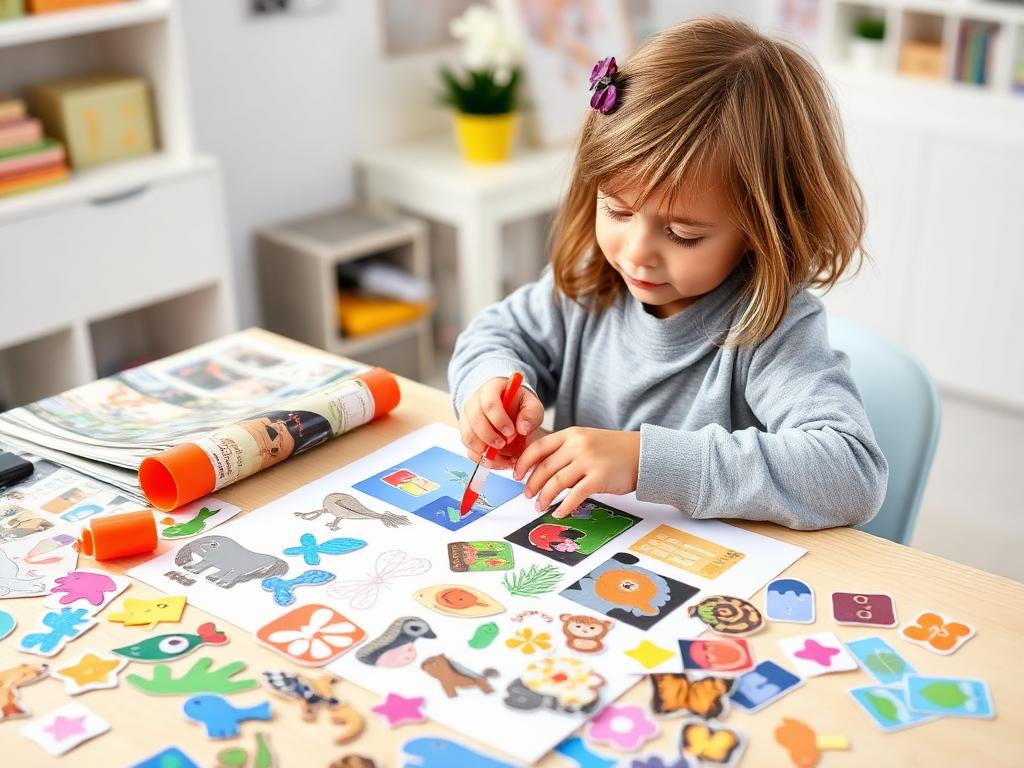
Old magazines become treasure troves when you're making collages. My kids love hunting for specific pictures: 'Find all the dogs!' or 'Find something blue!' Cutting and gluing their findings onto paper creates original artwork that's also a snapshot of their interests at this moment. My daughter's collage phase produced refrigerator-worthy art featuring exclusively horses, cupcakes, and the color pink. Years later, those collages remind me exactly who she was at four years old.
Age Safety Note
Safety scissors only, with close supervision. Preview magazines for age-inappropriate content before handing them over—even home magazines sometimes have surprising advertisements. Glue sticks are cleaner and safer than liquid glue. Ensure cut paper pieces are large enough not to be choking hazards if your child still mouths objects. Never leave young children alone with scissors.
Why This Activity Works
Magazine collage develops scissor skills in an engaging context—cutting out a picture is more motivating than cutting along a line. Visual discrimination improves as children search for specific items. Decision-making happens when choosing what to include and where to place it. And the resulting artwork allows children to express their current interests and obsessions without needing drawing skills.
Materials Needed
- Old magazines
Pre-screen for inappropriate content. Family-friendly publications work best.
- Safety scissors
Blunt-tipped with easy-grip handles.
- Large paper
Cardstock or construction paper as a base for gluing.
- Glue stick
Cleaner and safer than liquid glue for this age.
- Crayons
For adding details or backgrounds to the collage.
Prep Tips (Before You Start)
- 1Flip through magazines first to remove any inappropriate pages.
- 2Pull out pages with good pictures and set aside the rest.
- 3Decide on a theme if using one: 'Animals,' 'Food,' 'Things that are red.'
- 4Set up at a table with good light for easier picture-hunting.
- 5Have a 'scrap basket' for unwanted cut pieces.
Step-by-Step Guide
- 1Spread out magazine pages. 'Let's find pictures to cut out!'
- 2Give a theme or let child choose freely: 'Find things you like!'
- 3Help as needed with tricky cutting—thick magazine paper can be tough.
- 4When enough pictures are gathered, move to the gluing phase.
- 5Let child arrange pictures before gluing. 'Where do you want this one?'
- 6Glue pictures down. Press firmly for good adhesion.
- 7Add crayon details if desired: backgrounds, borders, connections between images.
- 8Discuss the finished collage: 'Tell me about what you included!'
Fun Variations to Try
- •Theme collages: animals, food, transportation, colors.
- •Alphabet collages: find pictures that start with each letter.
- •Vision board style: 'Things I love' or 'Things I want to try.'
- •Collaborative family collage where everyone contributes.
Cleanup Tips
- Recycle magazine scraps and unwanted pages.
- Small paper pieces attract messes—sweep up immediately.
- Store good magazine pages flat for future sessions.
- Glue sticks cap tightly to prevent drying out.
Real Parent Story
"Twins are a lesson in how different two kids can be. Mia and Noah approached magazine collage in completely opposite ways. Mia carefully cut around each picture, precise and methodical. She arranged and rearranged before gluing, wanting everything 'just right.' Her collages look like professional layouts. Noah, meanwhile, tore pages with wild abandon, slapped glue everywhere, and piled pictures on top of pictures in chaotic heaps. His collages look like explosions. They're both beautiful. They're both RIGHT. Magazine collage has become our rainy-day staple because it works for both personalities. Mia gets her control; Noah gets his chaos. They work side by side, each doing their thing, each creating something that's authentically THEM. I display their collages together, and the contrast makes me smile. Precision and chaos, side by side. That's parenting twins in a nutshell."
— Alex, parent of 4-year-old twins Mia and Noah
Bonus Tips From Parents
- Thicker magazine paper is harder to cut—help as needed.
- Glue the center of pictures, not just edges, to prevent lifting.
- Overlapping pictures creates visual interest—no need for neat arrangements.
- Date collages on the back—they're snapshots of your child's current interests.
References & Further Reading
General guidance we rely on when writing activities. These are broad resources rather than sources for this specific craft.
Toddler Ages & Stages
American Academy of Pediatrics
What to expect physically, socially and cognitively from 1 to 3 years.
The Power of Play
American Academy of Pediatrics
Why unstructured, hands-on play matters more than structured lessons at this age.
Choking Prevention
American Academy of Pediatrics
How to judge whether an object is a choking risk, and what to do if it happens.
Art Material Safety & the AP Seal
Art & Creative Materials Institute
Look up which craft supplies are certified non-toxic for children.
Toddler Play & Learning
Raising Children Network
Evidence-based play ideas grouped by developmental skill.
Poison Control
America's Poison Centers
Free 24/7 guidance if your child swallows something they shouldn't.
Ready for more fun?