Crinkle Paper Play
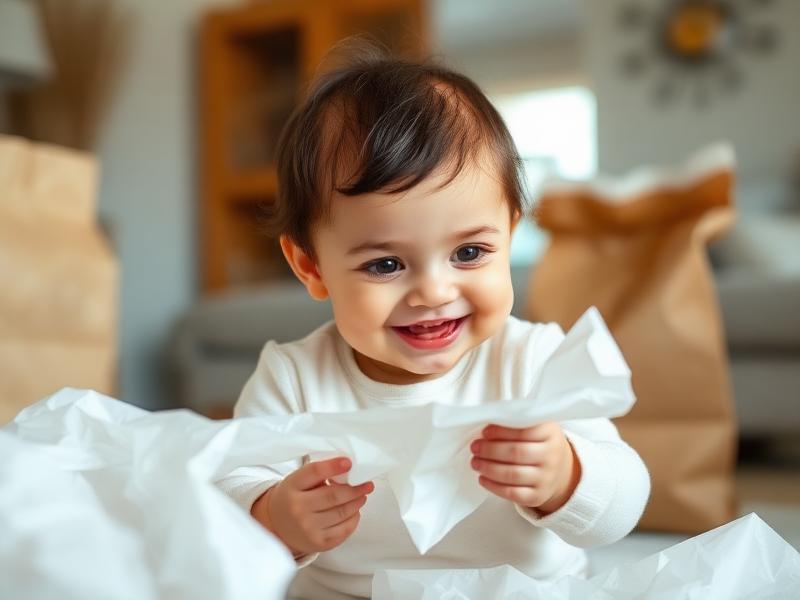
Before babies understand words or complex toys, they understand sound. And few sounds are as fascinating to a baby as the crinkling of paper. I discovered this accidentally when wrapping birthday presents while my daughter watched from her bouncy seat. The moment I crinkled tissue paper, her whole face lit up. She stopped fussing, leaned forward, and tried to grab the source of that magical noise. Crinkle paper play is one of the simplest activities in our rotation—it requires zero prep, costs nothing, and holds attention remarkably well. Just remember: supervision is key, because paper goes in mouths.
Age Safety Note
Paper is not a toy—it's a supervised sensory experience. Babies will put paper in their mouths, and small torn pieces can be choking hazards. Stay within arm's reach at all times, remove any small pieces immediately, and consider holding the paper while baby touches it if they're aggressive mouthers. Tissue paper is more delicate (tears easily into small pieces), while brown paper bags and parchment paper are sturdier options. Never use newspaper (ink is not safe) or magazine pages (glossy coating can be harmful).
Why This Activity Works
Sound-making activities teach cause and effect: baby moves hand, paper makes noise. This simple connection is profound for developing brains. The crinkly texture also provides tactile stimulation that's different from soft toys or smooth plastic. Crinkle paper play encourages reaching, grasping, and bilateral coordination (holding with two hands). And the repetitive sound can actually be calming for overstimulated babies—similar to white noise.
Materials Needed
- Tissue paper
The most satisfying crinkle sound. Use only under close supervision due to tearing.
- Brown paper bags
Sturdier than tissue paper, less likely to tear into small pieces.
- Wax paper
Different crinkle sound, more durable than tissue paper.
- Parchment paper
Food-safe and sturdy. Good for mouth-heavy babies.
- Fabric squares (optional)
For a DIY crinkle toy, sew paper between fabric layers.
Prep Tips (Before You Start)
- 1Clear the floor or table of other distractions so the paper is the focus.
- 2Have multiple pieces ready in case one gets too soggy or torn.
- 3Consider playing on a blanket for easy cleanup of torn pieces.
- 4Keep a trash bag nearby for quick disposal of wet or torn paper.
- 5For very mouthy babies, hold the paper rather than letting baby hold it independently.
Step-by-Step Guide
- 1Sit on the floor with your baby and produce a piece of crinkle paper.
- 2Crinkle it yourself first: 'Listen! What does it sound like?' Watch baby's reaction.
- 3Offer the paper to baby. Guide their hands if needed to make the crinkle sound.
- 4Celebrate the sound: 'You made it crinkle! Do it again!'
- 5Let baby explore: crinkle, shake, drop, pick up. Narrate their discoveries.
- 6If paper goes to mouth (it will), gently redirect: 'Paper is for crinkling, not eating.'
- 7When paper is wet or torn, swap for a fresh piece seamlessly.
- 8End before baby loses interest or gets frustrated—short sessions are fine!
Fun Variations to Try
- •Make a crinkle book: sew crinkle paper between fabric squares for a safe, washable version.
- •Create crinkle balls by loosely crumpling paper (supervised only—choking hazard if too small).
- •Play peek-a-boo with the paper, hiding your face behind it.
- •Use different papers and compare sounds: 'This one is loud! This one is quiet!'
Cleanup Tips
- Pick up all torn pieces immediately—small paper bits are choking hazards.
- Wet paper goes straight to the trash.
- Dry, uncrumpled paper can sometimes be reused if it's not too torn.
- Recycle paper waste—it's one of the more eco-friendly activities!
Real Parent Story
"We were stuck in a doctor's waiting room for two hours—a well-baby checkup that ran impossibly behind schedule. Theo was done. I was done. I'd exhausted every toy in the diaper bag. In desperation, I grabbed the paper liner from the exam table. The moment it crinkled, Theo stopped mid-whine. He looked at the paper like I'd just performed magic. I crinkled it again. He grabbed for it. For the next forty-five minutes, we crinkled that paper. He explored it with such focus and determination. He tried tasting it (I redirected). He threw it on the floor and wanted it back. He tried to tear it (couldn't—it was tough stuff). The nurses walking by probably thought I was crazy, but I didn't care. That piece of exam table paper saved my sanity. Now I always have a sheet of parchment paper in the diaper bag. Costs nothing, takes no space, entertains for ages. Sometimes the simplest things are the best things."
— David, dad of 13-month-old Theo
Bonus Tips From Parents
- The louder the crinkle, the more engaging for baby—tissue paper wins for sound.
- Some babies prefer soft crinkle sounds—experiment to find what captivates your child.
- Crinkle paper can help soothe a fussy baby when nothing else works.
- Make eye contact and smile while crinkling together—social connection enhances all play.
References & Further Reading
General guidance we rely on when writing activities. These are broad resources rather than sources for this specific craft.
Toddler Ages & Stages
American Academy of Pediatrics
What to expect physically, socially and cognitively from 1 to 3 years.
The Power of Play
American Academy of Pediatrics
Why unstructured, hands-on play matters more than structured lessons at this age.
Choking Prevention
American Academy of Pediatrics
How to judge whether an object is a choking risk, and what to do if it happens.
Art Material Safety & the AP Seal
Art & Creative Materials Institute
Look up which craft supplies are certified non-toxic for children.
Toddler Play & Learning
Raising Children Network
Evidence-based play ideas grouped by developmental skill.
Poison Control
America's Poison Centers
Free 24/7 guidance if your child swallows something they shouldn't.
Ready for more fun?