Finger Paint Masterpiece
My daughter's first 'painting' is framed in our hallway. It's a blur of blue and purple smears with a handprint blob in the corner. To anyone else, it's abstract chaos. To me, it's evidence of the afternoon my baby discovered she could make marks on the world. She stared at her paint-covered hand like she'd discovered magic. She tasted the paint (it was yogurt-based, so: fine). She smooshed her palms flat against the paper with such focus and intention. Art museums have nothing on that memory.
Age Safety Note
For 1-2 year olds, safety means edibility. Babies this age explore everything with their mouths, so your 'paint' should be something you're comfortable with them eating. Commercial finger paints labeled 'non-toxic' are fine for supervised use, but many parents prefer making edible paint from plain yogurt mixed with food coloring. Strip your baby down to a diaper—paint will get everywhere. Cover the floor under the high chair. Have a warm, wet washcloth ready for immediate post-painting cleanup. Never leave a baby unattended with any materials.
Why This Activity Works
Finger painting is one of the first art experiences many babies have, and it's loaded with developmental benefits. The sensory input of cool, squishy paint stimulates tactile development. The cause-and-effect learning—'when I move my hand, a mark appears'—is profound for a baby. Early mark-making is a precursor to writing; these smooshes and swirls are the very beginning of learning to make intentional shapes. And the emotional benefit is real too: creating something, having it celebrated, and seeing it displayed builds confidence and self-worth even in infants.
Materials Needed
- Non-toxic finger paints
Look for AP (Approved Product) seal, or make edible paint from yogurt + food coloring for the youngest babies.
- Large paper
Bigger is better. Butcher paper, poster board, or taped-together printer paper all work.
- High chair tray or tape
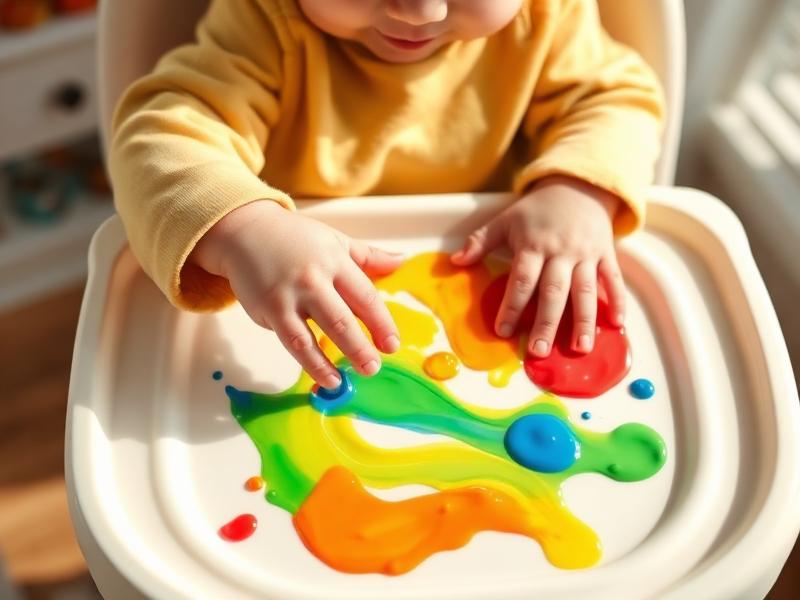
Secure the paper so it doesn't slide. A high chair tray is often the best 'canvas' for this age.
- Diaper (just a diaper)
Seriously, skip the clothes. You'll thank yourself.
- Warm wet washcloth
For immediate hand and face cleanup when the painting is done.
- Plastic floor cover
A shower curtain, cheap tablecloth, or old sheet under the painting area.
Prep Tips (Before You Start)
- 1Strip baby down to a diaper. This is not optional if you value your clothes and your sanity.
- 2Tape paper firmly to the high chair tray or table. Sliding paper frustrates everyone.
- 3Put small dollops of paint on the paper—start with one or two colors. You can always add more.
- 4Cover the floor with something washable. Paint will end up there.
- 5Keep wet washcloths within arm's reach. You'll need them.
Step-by-Step Guide
- 1Secure your baby in their high chair with paper taped to the tray, and put paint dollops in front of them.
- 2Point to the paint and touch it yourself first. 'Look! It's squishy! Touch it!'
- 3Let your baby explore at their own pace. Some dive right in; others are hesitant and need time.
- 4Narrate what you see: 'You're making a red swirl! Your hands are blue! Smoosh smoosh smoosh!'
- 5If they put paint in their mouth (they will), stay calm. Edible/non-toxic paint means this is okay.
- 6Add more colors if they want, or let them work with what they have. Follow their lead.
- 7When interest fades or baby seems done, say 'All done painting! Let's clean up!' Keep it positive.
- 8Wipe hands and face immediately with warm wet washcloths. Then head to the bath if needed.
- 9Let the artwork dry flat. Later, date it, frame it, cherish it forever.
Fun Variations to Try
- •Use pudding instead of paint for a fully edible (and delicious) sensory experience.
- •Tape paper to a window for a vertical painting experience—gravity adds new challenges.
- •Put paint in a sealed ziplock bag taped to the high chair for mess-free sensory play.
- •Do this in the bathtub for the easiest possible cleanup—just rinse everything down the drain!
Cleanup Tips
- Warm water and a washcloth handle hands, face, and body. Soap is usually overkill for non-toxic paint.
- Don't try to clean baby AND admire artwork simultaneously. One parent wipes, one parent rescues the painting.
- Dried paint on high chair trays wipes off easier if you soak a wet cloth on it for a few minutes.
- Bath time naturally follows finger painting—don't even try to skip it.
Real Parent Story
"I grew up in a 'don't make a mess' household, so letting my baby smear paint everywhere went against every instinct I had. My wife set up the painting station, stripped Zoe to her diaper, and I just... watched. At first, Zoe just stared at the paint blobs on her tray. Then she poked one with her finger. Then she looked at her finger, looked at the paint, and poked again. I swear I saw her brain working: 'The stuff moved. When I touch it, it moves.' Then she went full baby-smash mode, palms down, smooshing paint everywhere, laughing with her whole body. She tasted the blue (it was yogurt-based, so fine). She got it in her hair. She painted her belly. By the end, she was more purple than pink. And the 'painting' she made—just smears of overlapping color—is now framed in our hallway. Visitors probably think we're weird art collectors. We don't tell them it was made by a one-year-old having the time of her life. That afternoon changed me as a parent. Messes are okay. Joy is worth cleaning up. And my kid is an artist, even if her medium is yogurt."
— David, dad of 14-month-old Zoe
Bonus Tips From Parents
- Take photos before cleanup! Paint-covered babies are peak adorableness.
- Your reaction matters—excited 'wow!' responses encourage more creating.
- If baby seems overstimulated, try one color at a time next session.
- The 'art' is in the process, not the product. The paper is just a souvenir of the experience.
References & Further Reading
General guidance we rely on when writing activities. These are broad resources rather than sources for this specific craft.
Toddler Ages & Stages
American Academy of Pediatrics
What to expect physically, socially and cognitively from 1 to 3 years.
The Power of Play
American Academy of Pediatrics
Why unstructured, hands-on play matters more than structured lessons at this age.
Choking Prevention
American Academy of Pediatrics
How to judge whether an object is a choking risk, and what to do if it happens.
Art Material Safety & the AP Seal
Art & Creative Materials Institute
Look up which craft supplies are certified non-toxic for children.
Toddler Play & Learning
Raising Children Network
Evidence-based play ideas grouped by developmental skill.
Poison Control
America's Poison Centers
Free 24/7 guidance if your child swallows something they shouldn't.
Ready for more fun?