
Music and Shaker Play
Use a commercially manufactured, age-labeled shaker for supervised music play. This guide covers adult setup, a simple turn-taking activity, and safe storage.
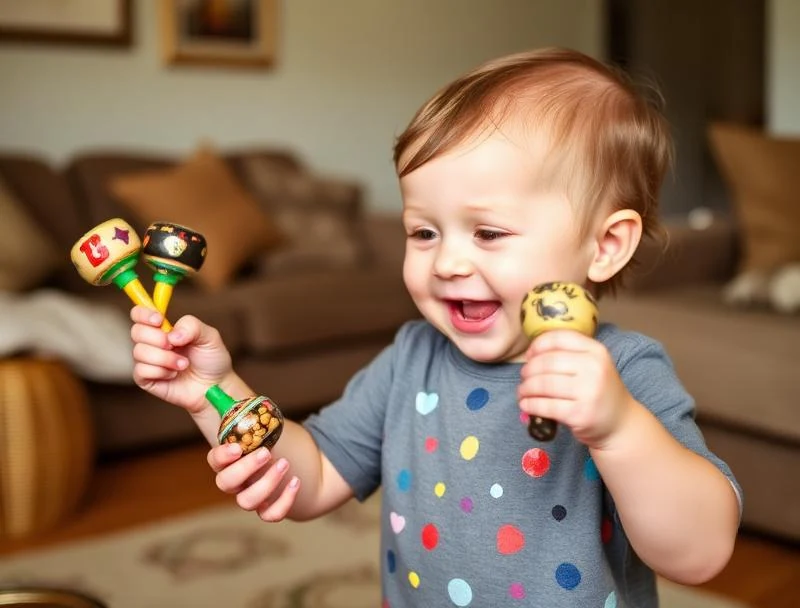
Age Safety Note
Do not make shakers from containers filled with loose rice, beans, pasta, or other small items; tape and glue cannot guarantee that fillers stay sealed. Use an intact shaker labeled for the child's age, inspect it according to its product directions, supervise closely, and keep it away from mouths.
What This Activity Offers
Different age-appropriate, commercially made shakers can make different sounds when moved; adults can compare them or keep a simple beat together. Avoid homemade loose-fill containers, since tape cannot guarantee that small fillers remain inaccessible.
Materials Needed
- Commercially manufactured shaker labeled for the child's age
Use only an intact product labeled for the child's age; do not refill or modify it.
- No loose fillers
Do not add small loose items to an improvised container.
- Stable play area
Clear trip hazards and supervise play; tape is not a substitute for an age-labeled toy.
- Caregiver supervision
Stay close and stop if the child mouths or damages the shaker.
- No decorations
Use the product as supplied; do not attach decorations that could loosen.
Prep Tips (Before You Start)
- 1Check the shaker's age label and condition; do not refill or modify it.
- 2Do not prepare or offer loose fillers.
- 3Clear a stable play area and keep the shaker away from mouths.
- 4Do not use a homemade filled container as a toddler shaker; a seal test cannot guarantee it will remain closed.
- 5Have a playlist of upbeat kid music ready to go for the post-craft dance party.
Step-by-Step Guide
- 1Show the intact, age-labeled shaker and keep it in the supervised play area.
- 2Take turns shaking an age-labeled instrument and pausing to listen; do not add loose fillers.
- 3Keep the shaker intact; do not open, refill, or modify it.
- 4An adult checks the toy for damage before play and follows its product directions.
- 5Hand back to your toddler and demonstrate shaking. Listen to the sound.
- 6If another instrument is used, it must also be an intact, age-labeled product.
- 7Do not attach decorations that could loosen; use the product as supplied.
- 8Turn on music and start a dance party with the new instruments.
Fun Variations to Try
- •An adult can compare two intact, age-labeled shakers, one at a time.
- •Do not use or decorate refillable containers as improvised shakers.
- •Use two intact, age-labeled instruments with different sounds; do not add loose fillers.
- •Try rhythm games: shake fast, shake slow, shake-stop-shake.
Cleanup Tips
- Store shakers in a basket for easy access.
- Inspect the manufactured shaker as directed and stop using it if damaged.
- If any contents spill or a shaker is damaged, remove all loose pieces and discontinue use.
- Save shakers—they get used for years.
Additional Tips
- Use only the sounds of intact, age-labeled instruments; do not open them to compare fillers.
- Do not tape instruments together or alter the product.
- Adults can join the band too—dignity is overrated.
- For gifts, use only intact instruments labeled for each recipient's age.
References & Further Reading
General background resources for readers. They do not verify or test any specific activity, material, or setup described on this site.
Toddler Ages & Stages
American Academy of Pediatrics
What to expect physically, socially and cognitively from 1 to 3 years.
The Power of Play
American Academy of Pediatrics
An overview of play and its place in early childhood.
Choking Prevention
American Academy of Pediatrics
General guidance on choking risks and prevention for children.
Small Parts and Choking Hazard Labeling FAQs
U.S. Consumer Product Safety Commission
Explains U.S. small-parts rules and choking-hazard labels for children's products; household materials still need separate adult judgment.
Water Safety and Young Children
American Academy of Pediatrics
Guidance on close supervision around water and emptying open containers after use.
Lead in Soil
U.S. Environmental Protection Agency
Explains soil exposure during play and recommends preventing soil eating and washing exposed skin after contact.
Preventing Window Falls
U.S. Consumer Product Safety Commission
Window guards, stops, and keeping furniture away from windows can help reduce fall risks.
Art Material Safety & the AP Seal
Art & Creative Materials Institute
Explains the ACMI certification seals used on some art and creative materials.
Toddler Play & Learning
Raising Children Network
Play ideas and age-based information for caregivers.
Poison Control
America's Poison Centers
Free 24/7 guidance if your child swallows something they shouldn't.
Ready for more fun?