Mirror Play Discovery
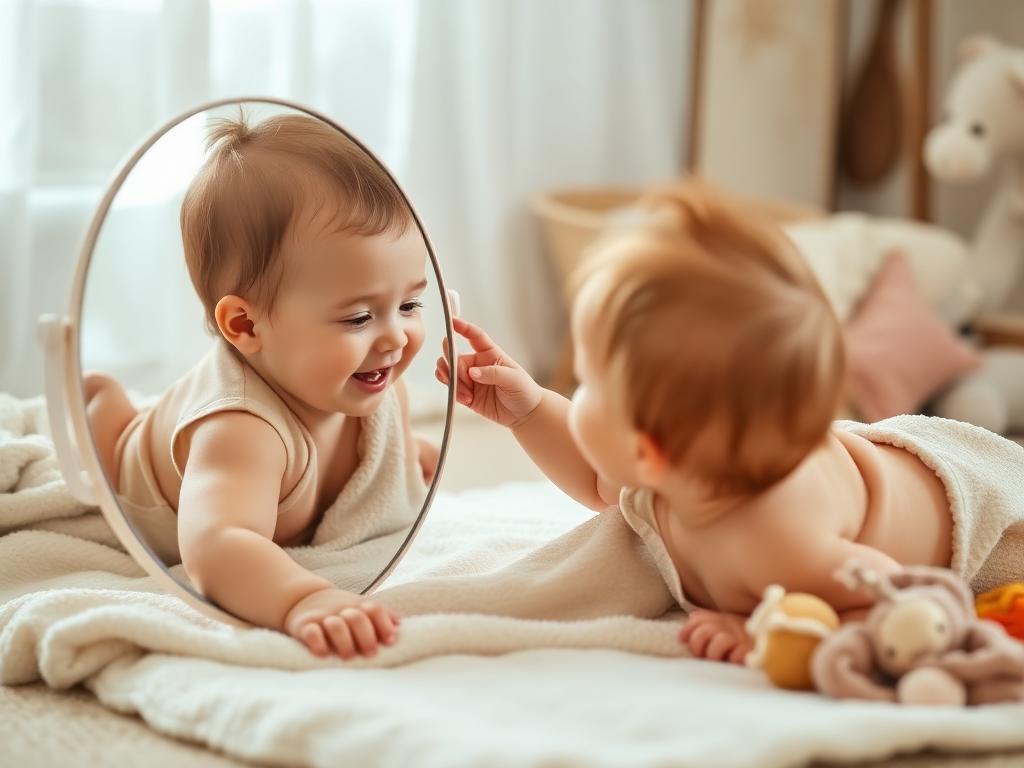
There's a moment around 18 months when babies recognize themselves in mirrors—really recognize, not just see an interesting baby-shaped thing. My daughter discovered herself in the bathroom mirror, pointed, and said 'baby.' Then she pointed at me and said 'mama.' Then back at herself: 'baby.' She understood. That moment of self-recognition is a developmental milestone, and it happened during spontaneous mirror play. Now we do mirror play intentionally: making faces, playing peek-a-boo, exploring expressions. The mirror reflects back the most fascinating subject in any baby's world: themselves.
Age Safety Note
Only use unbreakable, baby-safe mirrors. Real glass mirrors can shatter dangerously. Acrylic mirrors, baby mirrors, or mirror books are safe alternatives. Check mirrors before each use for any cracks, chips, or sharp edges. If using a wall mirror, ensure it's securely mounted and baby can't pull it down. Handheld mirrors should be sturdy with no small parts that could detach. Free-standing mirrors should have stable bases that can't tip.
Why This Activity Works
Mirror play develops self-awareness and social-emotional skills. When babies see their reflections, they're learning about identity and self-concept. Making faces in mirrors develops emotional recognition. Watching a parent's face in the mirror alongside their own builds understanding of relationships. The back-and-forth of peek-a-boo in a mirror teaches object permanence. And for language development, mirrors provide a perfect opportunity to label body parts: eyes, nose, mouth, ears.
Materials Needed
- Unbreakable baby mirror
Acrylic mirrors designed for babies are ideal—light, safe, and portable.
- Soft toys
Stuffed animals to include in mirror play and practice labeling.
- Fabric scarves
For peek-a-boo games in front of the mirror.
- Towel to lay on
For tummy time mirror play on the floor.
Prep Tips (Before You Start)
- 1Choose a well-lit location where the mirror shows clear reflections.
- 2Position baby comfortably—sitting supported, in a high chair, or during tummy time.
- 3Have scarves and toys within reach for games.
- 4Check the mirror for any cracks or damage before play.
- 5Prepare to make silly faces—mirror play requires parental participation!
Step-by-Step Guide
- 1Position yourself and baby in front of the mirror together.
- 2Point to baby's reflection: 'Who's that? That's YOU! That's [baby's name]!'
- 3Point to your reflection: 'And who's that? That's Mama/Dada!'
- 4Make a silly face and watch baby's reaction. 'Silly face! Can you make a silly face?'
- 5Play peek-a-boo with a scarf: hide behind it, appear in the mirror, celebrate!
- 6Point to body parts in the reflection: 'Where's your nose? There's your nose!'
- 7Hold up a toy in the mirror: 'Look, teddy is in the mirror too!'
- 8Let baby explore independently—touching the mirror, moving, watching reflections change.
Fun Variations to Try
- •Use mirrors during tummy time to encourage lifting and looking.
- •Play with sunglasses or hats in front of mirrors for dress-up fun.
- •Make faces showing different emotions: happy, sad, surprised, angry.
- •Take turns: 'You make a face, now I copy!' Builds social reciprocity.
Cleanup Tips
- Wipe mirrors with a soft cloth—fingerprints accumulate quickly!
- Store mirrors flat to prevent scratching.
- Check periodically for any damage that could create safety hazards.
- Replace mirrors if they become scratched or clouded.
Real Parent Story
"Emma was a serious baby. Not unhappy—just serious. She observed everything with a furrowed brow, like she was constantly analyzing the world. Smiles were rare and earned. Then I bought a baby mirror for tummy time. The moment Emma saw herself, her face changed. She smiled at her reflection. She babbled at her reflection. She laughed at her reflection. It was like meeting a friend she instantly connected with. Now we do mirror play every day. I sit behind her and we make faces together. I started with exaggerated expressions—huge smiles, wide eyes, surprised O-mouths—and she began copying. Now SHE initiates faces and waits for ME to copy. Our serious baby found a way to play. She still furrow-brows at the world, but in front of the mirror, she's goofy and free. That mirror showed me a side of my daughter I didn't know existed."
— Carla, mom of 14-month-old Emma
Bonus Tips From Parents
- Babies under 18 months usually don't recognize themselves—they think it's another baby. That's normal!
- Self-recognition typically develops between 18-24 months. Watch for pointing at their own reflection.
- Mirror play is especially good for shy or reserved babies—the 'other baby' feels safe.
- Take photos of baby looking at their reflection—these shots are especially adorable.
References & Further Reading
General guidance we rely on when writing activities. These are broad resources rather than sources for this specific craft.
Toddler Ages & Stages
American Academy of Pediatrics
What to expect physically, socially and cognitively from 1 to 3 years.
The Power of Play
American Academy of Pediatrics
Why unstructured, hands-on play matters more than structured lessons at this age.
Choking Prevention
American Academy of Pediatrics
How to judge whether an object is a choking risk, and what to do if it happens.
Art Material Safety & the AP Seal
Art & Creative Materials Institute
Look up which craft supplies are certified non-toxic for children.
Toddler Play & Learning
Raising Children Network
Evidence-based play ideas grouped by developmental skill.
Poison Control
America's Poison Centers
Free 24/7 guidance if your child swallows something they shouldn't.
Ready for more fun?