Paper Bag Puppet Show
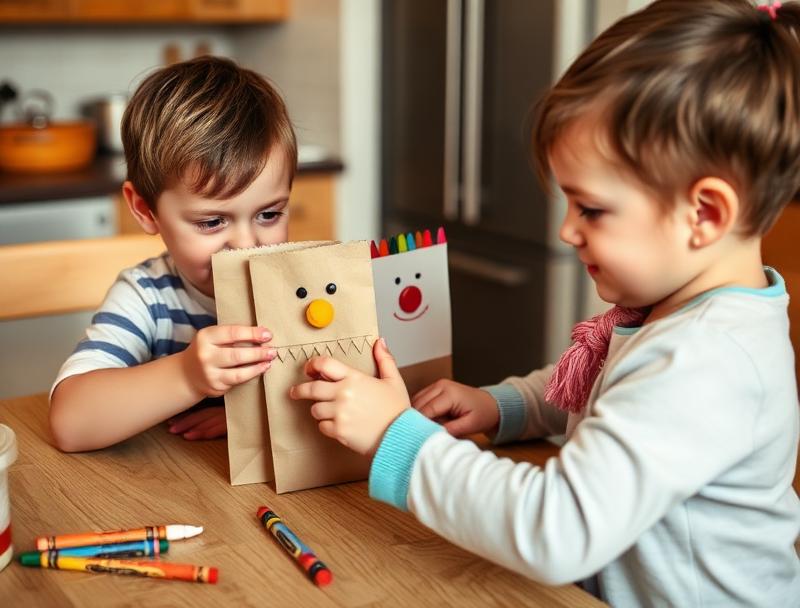
Paper bag puppets have been entertaining children for generations, and there's a reason they've endured. They're simple to make, utterly customizable, and provide endless opportunity for imaginative play. My son made a 'family' of paper bag puppets: one for each of us plus our dog. Now he puts on shows where the puppet versions of our family go on wild adventures—to space, under the ocean, to a land made entirely of candy. The stories he tells through those puppets reveal his inner world in ways conversation never would. Puppets give children a voice that sometimes feels safer than their own.
Age Safety Note
Paper bag puppets are among the safest crafts for 3-4 year olds. The materials—paper bags, crayons, glue sticks, and yarn—are all non-toxic and low-risk. If adding googly eyes, use the large plastic kind and glue them securely; small button eyes are choking hazards. Scissors should be safety scissors with close supervision. Paper bags pose no suffocation risk at this age when used for puppets rather than placed over heads—but it doesn't hurt to reinforce 'bags are for puppets, not for wearing.'
Why This Activity Works
Puppets are powerful tools for social-emotional development. Children often say things through puppets that they wouldn't say as themselves—feelings, fears, hopes, and frustrations all come out in puppet play. The creation process develops fine motor skills, color recognition, and creative decision-making (what should this character look like?). And puppet shows build narrative skills: beginning, middle, end, dialogue, character development. All of this happens naturally, joyfully, in the context of play. Add in the dramatic play that follows craft time, and paper bag puppets deliver hours of developmental benefit for the cost of a paper bag.
Materials Needed
- Paper lunch bags
Brown bags work best—the fold at the bottom becomes the puppet's mouth.
- Crayons or markers
For drawing faces, clothes, and other features.
- Yarn
For hair. Pre-cut into 3-4 inch pieces for easier handling.
- Glue stick
Faster drying and less messy than liquid glue for this project.
- Construction paper
For cutting shapes to add as features: ears, bow ties, hats.
- Safety scissors
For cutting construction paper shapes with supervision.
Prep Tips (Before You Start)
- 1Pre-cut yarn into hair-length pieces so it's ready for gluing.
- 2If your child isn't confident with scissors, pre-cut construction paper shapes too.
- 3Open a paper bag and demonstrate how the fold becomes a 'mouth' that opens and closes when your hand is inside.
- 4Set up a protected work surface—markers can bleed through paper bags onto tables.
- 5Have a few puppet examples ready or look at pictures online for inspiration.
Step-by-Step Guide
- 1Discuss who the puppet will be: 'Do you want to make a person, an animal, or a monster?'
- 2Show how the bag's fold becomes a mouth. Draw eyes on the flap and a tongue inside the fold.
- 3Add facial features: nose, eyebrows, eyelashes, cheeks—whatever feels right for the character.
- 4Glue yarn for hair on top of the bag. 'What color hair? Long or short?'
- 5Add construction paper details: ears, hats, bow ties, glasses, buttons.
- 6Let the puppet dry for a few minutes while you discuss the character's personality. 'What's their name? What do they like?'
- 7Put your hand inside the puppet and bring it to 'life.' Use a silly voice! Have a conversation with your child's puppet.
- 8Set up a puppet show: drape a blanket over chairs for a stage, or use the back of a couch.
Fun Variations to Try
- •Make matching animal puppets and act out animal stories.
- •Create puppets based on favorite book characters.
- •Make holiday puppets: Santa, the Easter Bunny, a Thanksgiving turkey.
- •Use large grocery bags for body puppets that go over hands and arms.
Cleanup Tips
- Store finished puppets in a dedicated box or basket near the play area.
- Leftover yarn and construction paper scraps store well in ziplock bags for future crafts.
- Glue stick wipes off tables easily with a damp cloth.
- If markers bled through bags onto the table, a little rubbing alcohol removes most inks.
Real Parent Story
"Grace was struggling when her baby brother was born. She wasn't acting out—she was withdrawing. She'd always been our chatty kid, but suddenly she was quiet and sullen. We tried talking to her about her feelings, but she'd just say 'I'm fine' and walk away. Then her preschool teacher suggested puppets. I made a simple paper bag puppet of a big sister character, and Grace made a puppet of a baby. We started playing together, and the puppets told stories. The big sister puppet said she was sad because the baby got all the attention. The big sister puppet said she missed being the only kid. The big sister puppet asked the baby puppet to go away. It was hard to hear, but it was REAL, and she couldn't have said it without the puppet as a buffer. Over weeks of puppet play, Grace worked through her feelings. We talked through the puppets about how our family has enough love for everyone. The big sister puppet eventually became friends with the baby puppet. And Grace? She started talking again, started laughing again, started being our chatty kid. Those paper bag puppets were better therapy than anything a professional could have provided. I'll never underestimate the power of play."
— Kevin, dad of 4-year-old Grace
Bonus Tips From Parents
- Puppets don't have to be perfect—wonky eyes and crooked hair give them character.
- Join the puppet show! Make your own puppet and participate in the storytelling.
- Video puppet shows to watch later—kids love seeing their performances.
- Listen carefully to puppet dialogue—children often reveal important feelings through play.
References & Further Reading
General guidance we rely on when writing activities. These are broad resources rather than sources for this specific craft.
Toddler Ages & Stages
American Academy of Pediatrics
What to expect physically, socially and cognitively from 1 to 3 years.
The Power of Play
American Academy of Pediatrics
Why unstructured, hands-on play matters more than structured lessons at this age.
Choking Prevention
American Academy of Pediatrics
How to judge whether an object is a choking risk, and what to do if it happens.
Art Material Safety & the AP Seal
Art & Creative Materials Institute
Look up which craft supplies are certified non-toxic for children.
Toddler Play & Learning
Raising Children Network
Evidence-based play ideas grouped by developmental skill.
Poison Control
America's Poison Centers
Free 24/7 guidance if your child swallows something they shouldn't.
Ready for more fun?