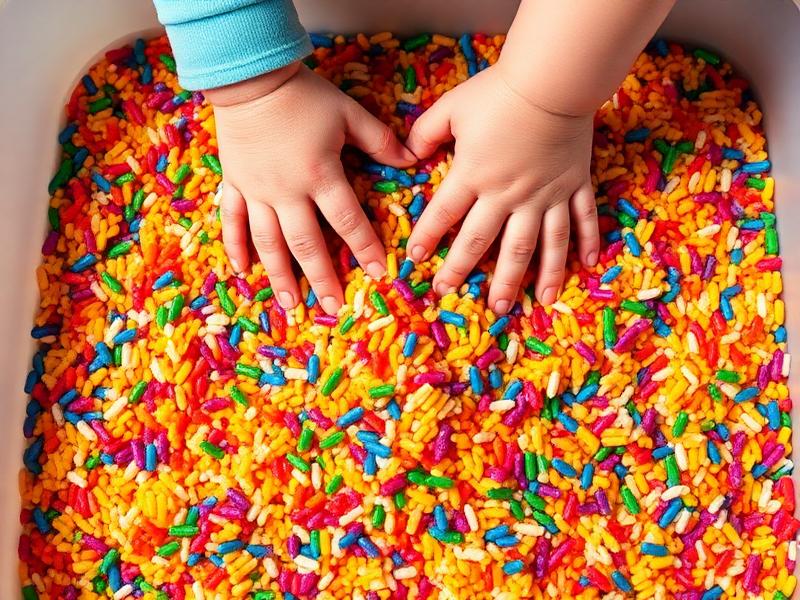
Rainbow Rice Sensory Bin
I remember standing in my kitchen at 6 AM, shaking ziplock bags of rice and food coloring like some kind of sleep-deprived maraca player. My 15-month-old was going through a phase where nothing entertained her for more than two minutes—except, as I discovered that morning, rainbow rice. We set up a shallow bin on the kitchen floor, and she played for forty-five uninterrupted minutes. I got to drink an entire cup of coffee while it was still hot. That alone was worth the effort of dying rice at dawn.
Age Safety Note
For babies 12-18 months who still put everything in their mouths, use cooked and cooled rice—it's safe if swallowed. For older toddlers (18-24 months) who have mostly stopped mouthing, uncooked rice is fine but still requires supervision. Always stay close by. The rice should be in a shallow container that can't tip over, and the play area should be easy to sweep or vacuum afterward.
Why This Activity Works
Sensory bins provide exactly the kind of input developing brains crave. The rice offers tactile stimulation, the colors engage visual processing, and the sounds of scooping and pouring provide auditory feedback. For 1-2 year olds, the simple actions of transferring rice between containers builds hand-eye coordination and teaches cause and effect. It's also wonderfully calming—the repetitive scooping motion has an almost meditative quality that can settle an overstimulated toddler.
Materials Needed
- White rice
About 2-3 cups per color. Long grain works best—it doesn't clump as much.
- Food coloring
Gel colors are more vibrant than liquid. A little goes a long way.
- White vinegar
A tablespoon per bag helps the color stick and speeds drying.
- Ziplock bags
One per color for mixing and dyeing.
- Shallow container
Baking pan, under-bed storage bin, or large Tupperware. Wide and shallow is better than deep.
- Cups, spoons, funnels
Assorted scooping and pouring tools of different sizes.
Prep Tips (Before You Start)
- 1Dye the rice the night before or early morning—it needs 2-3 hours to dry completely.
- 2Add rice, a few drops of food coloring, and a splash of vinegar to each bag. Seal and shake vigorously.
- 3Spread colored rice on a baking sheet lined with parchment paper to dry. Stir occasionally.
- 4Layer dried colors in the bin for maximum visual impact—stripes or sections both look great.
- 5Set up near an easy-to-clean floor. A shower curtain or old sheet underneath catches stray rice.
Step-by-Step Guide
- 1Present the rainbow rice bin with a few simple tools—start with just one cup and one spoon to avoid overwhelm.
- 2Sit on the floor beside your child and demonstrate scooping and pouring. 'Scoop, scoop... POUR!' Make it playful.
- 3Let your child explore at their own pace. Some babies want to run fingers through it; others go straight for pouring.
- 4Narrate what you see: 'You're pouring the blue rice! It's falling into the cup!'
- 5Add new tools as interest grows—a funnel, a larger container, a slotted spoon for sifting.
- 6Bury small toys in the rice for a 'treasure hunt' variation if regular scooping loses appeal.
- 7When attention shifts, it's time to clean up. Make sweeping or vacuuming part of the game if possible.
Fun Variations to Try
- •Add texture variety by mixing in dried pasta, pom poms, or fabric scraps.
- •Freeze small toys in ice cubes and bury them in the rice for a cold surprise hunt.
- •Use seasonal themes: orange and black for Halloween, red and green for Christmas, pastels for spring.
- •Create a 'farm' or 'construction' bin by adding relevant toy animals or vehicles.
Cleanup Tips
- Store rice in airtight containers between uses—it lasts for months if kept dry.
- A handheld vacuum or dustpan and brush are your best friends for stray rice.
- Shake out your child's clothes before leaving the play area. Rice hides in pockets, socks, and diapers.
- If rice gets wet during play, let it dry completely before storing or it will mold.
Real Parent Story
"Rainbow rice saved my sanity during the winter Kai turned one. We were stuck inside for weeks during a particularly brutal January, and I was running out of activities. The rice bin became our morning ritual—after breakfast, while I cleaned up dishes, Kai would sit on the kitchen floor scooping and pouring. Some mornings he'd play quietly for half an hour; other times he'd lose interest after ten minutes. But even ten minutes of engaged play was enough for me to load the dishwasher and take a breath. By the end of winter, we'd refined our setup: a shower curtain under the bin, his little chair so he could reach comfortably, and a designated 'rice drawer' where all the scooping tools lived. Now he runs to that drawer every morning after breakfast and points at it. Rice play isn't just an activity for us—it's become a beloved routine that brings both of us joy."
— Jordan, parent of 16-month-old Kai
Bonus Tips From Parents
- Refresh rice colors occasionally—they fade over time but can be re-dyed easily.
- If your child insists on throwing rice, redirect to pouring from higher up: 'Let's pour from up HIGH!'
- Playing music softly in the background enhances the calming effect.
- Let your child 'help' you dye the rice—shaking the bags is half the fun!
References & Further Reading
General guidance we rely on when writing activities. These are broad resources rather than sources for this specific craft.
Toddler Ages & Stages
American Academy of Pediatrics
What to expect physically, socially and cognitively from 1 to 3 years.
The Power of Play
American Academy of Pediatrics
Why unstructured, hands-on play matters more than structured lessons at this age.
Choking Prevention
American Academy of Pediatrics
How to judge whether an object is a choking risk, and what to do if it happens.
Art Material Safety & the AP Seal
Art & Creative Materials Institute
Look up which craft supplies are certified non-toxic for children.
Toddler Play & Learning
Raising Children Network
Evidence-based play ideas grouped by developmental skill.
Poison Control
America's Poison Centers
Free 24/7 guidance if your child swallows something they shouldn't.
Ready for more fun?