Rainbow Scratch Art
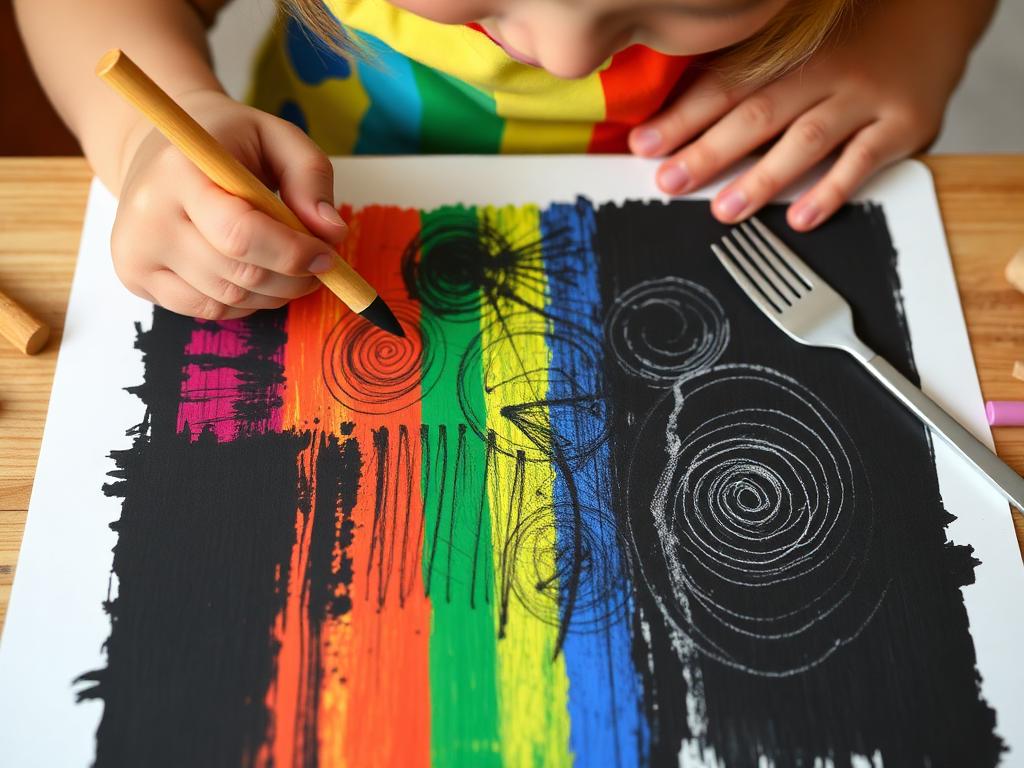
Rainbow scratch art was the activity that made my four-year-old gasp out loud. We spent fifteen minutes coloring rainbow stripes on heavy paper, then another fifteen minutes covering them entirely in thick black crayon. He looked at me, confused. 'It's all black, Mommy.' Then I handed him a plastic fork and showed him what to do. The first scratch revealed a streak of bright pink underneath the black, and his eyes went enormous. 'It's MAGIC,' he whispered. We spent the next hour creating scratch masterpieces. That look of pure wonder is why I keep crafting with him.
Age Safety Note
The scratching tool matters. Wooden skewers have sharp points and should only be used with close adult supervision—or skip them entirely in favor of plastic forks, toothpicks with rounded tips, or specialty scratch art tools. Never let children run with the scratching tool. Color the paper at a table with newspaper underneath; black crayon shavings get everywhere. If your child rubs their eyes, the black wax can transfer—keep a wet cloth nearby for quick cleanups.
Why This Activity Works
Rainbow scratch art delivers a payoff toddlers rarely experience: a true magic moment. The buildup of coloring and then covering feels almost like work—and then the reveal makes it all worthwhile. This builds patience and delayed gratification, which are crucial preschool skills. The fine motor work of pressing hard with crayons builds hand strength. The scratching itself develops precision and control. And the artistic possibilities are endless: scribbles, names, drawings, secret messages. Each scratch piece is unique and totally surprising.
Materials Needed
- Heavy paper
Cardstock or watercolor paper. Regular printer paper tears.
- Bright crayons
Red, orange, yellow, green, blue, purple, pink—the more colors the better.
- Black crayon
A full new black crayon. You'll use a lot of it.
- Wooden skewer or plastic fork
Scratching tool. Plastic fork is the safer option.
- Newspaper
To protect the table from wax shavings.
Prep Tips (Before You Start)
- 1Use thick paper—thin paper tears under heavy crayon pressure.
- 2Have all crayons sharpened and ready, especially the black one.
- 3Set up at a table with newspaper underneath.
- 4Plan for the coloring step to take longer than expected.
- 5Have a paper towel ready to wipe wax buildup off scratching tools.
Step-by-Step Guide
- 1Hand your child the colored crayons. 'Cover the whole paper with rainbow stripes.'
- 2Encourage pressing hard—the more wax, the better the final reveal.
- 3Once the paper is colorful, switch to the black crayon.
- 4Cover the entire rainbow with thick, opaque black. Press hard.
- 5Take a moment to admire the all-black paper. 'Looks like nothing, right? Watch this.'
- 6Demonstrate scratching: gently drag the tool across the paper to reveal color.
- 7Hand the tool to your child. Watch their face.
- 8Let them scratch freely—designs, names, scribbles, anything.
Fun Variations to Try
- •Scratch a self-portrait or a family scene.
- •Make scratch art greeting cards with secret messages.
- •Try metallic crayons under the black for a shimmer reveal.
- •Create a starry night scene by scratching dots and crescents.
Cleanup Tips
- Shake wax shavings off newspaper before throwing it away.
- Wipe scratching tools clean and store for reuse.
- Black crayon can stain clothes—remove smocks carefully.
- Display finished pieces in clear sleeves to protect from smudging.
Real Parent Story
"Marcus is a kid who needs to understand the why of everything. So when I told him we were coloring a paper just to cover it with black, he resisted. 'But why?' I asked him to trust me. He grudgingly colored the rainbow stripes, then complained the whole time he was covering them in black. When I handed him the fork and he made that first scratch—I'll never forget his face. He didn't speak for a full ten seconds. Then he whispered, 'Daddy, did you know this would happen?' I nodded. He hugged me and said, 'You're a magician.' Best craft moment of my life, hands down."
— Devon, dad of 4-year-old Marcus
Bonus Tips From Parents
- A bingo dauber dipped in black tempera paint covers crayon faster than a black crayon.
- Store finished pieces flat to prevent the black layer from cracking.
- Older kids can write hidden messages for siblings to discover.
- Premade scratch paper exists, but homemade is more meaningful (and cheaper).
References & Further Reading
General guidance we rely on when writing activities. These are broad resources rather than sources for this specific craft.
Toddler Ages & Stages
American Academy of Pediatrics
What to expect physically, socially and cognitively from 1 to 3 years.
The Power of Play
American Academy of Pediatrics
Why unstructured, hands-on play matters more than structured lessons at this age.
Choking Prevention
American Academy of Pediatrics
How to judge whether an object is a choking risk, and what to do if it happens.
Art Material Safety & the AP Seal
Art & Creative Materials Institute
Look up which craft supplies are certified non-toxic for children.
Toddler Play & Learning
Raising Children Network
Evidence-based play ideas grouped by developmental skill.
Poison Control
America's Poison Centers
Free 24/7 guidance if your child swallows something they shouldn't.
Ready for more fun?