Stacking Soft Blocks
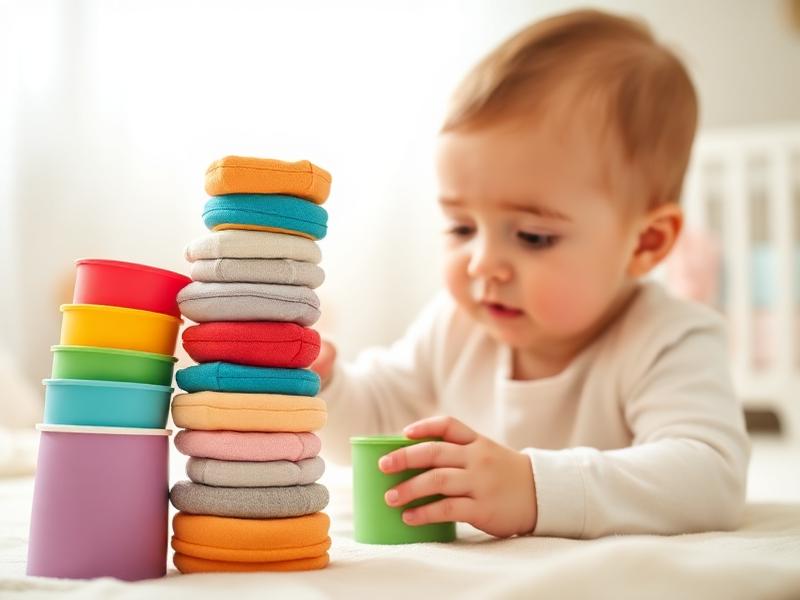
Before my daughter could walk, she could knock down towers. This was not destruction—it was physics. She'd watch intently as I stacked two, three, four soft blocks, and the moment the tower wobbled, she'd swipe it with pure glee. Then we'd do it again. And again. And again. Stacking and knocking became our game, our language, our way to laugh together. When she finally stacked her own block on top of mine—at around 14 months—I celebrated like she'd won an Olympic medal. Because in the world of baby development, stacking a block is a major achievement.
Age Safety Note
Soft blocks are among the safest toys for this age group, but some considerations apply. Use only age-appropriate blocks that are large enough not to fit in a mouth. Fabric blocks should have securely sewn seams with no loose threads. Foam blocks should be dense and non-crumbly—cheap foam can break into small pieces. Avoid hard wooden or plastic blocks for young babies who might fall on them or throw them at faces. The soft landing of a knocked-down fabric tower is part of what makes this activity safe and fun.
Why This Activity Works
Stacking teaches concepts that are hard to explain but easy to experience: balance, gravity, spatial relationships. When a tower falls, babies learn about cause and effect. When they stack successfully, they experience achievement and develop confidence. The fine motor control required to place one block atop another is significant at this age. And the predictable pattern of 'stack-knock-stack-knock' is deeply satisfying for babies who are just beginning to understand how the world works.
Materials Needed
- Soft fabric blocks
Cloth blocks with soft filling are ideal—they're safe, light, and satisfying to knock down.
- Empty tissue boxes
Lightweight and stackable. Cover rough edges with tape if needed.
- Stacking cups
Doubles as blocks when inverted. Great for nesting too.
- Foam blocks
Dense foam works well—avoid crumbly or cheap foam that breaks into pieces.
Prep Tips (Before You Start)
- 1Clear a flat, stable surface for stacking—carpet works great because towers don't slide.
- 2Start with just 3-5 blocks to avoid overwhelming baby with choices.
- 3Sit at baby's level so you can stack together face-to-face.
- 4Have blocks within baby's reach so they can grab and contribute.
- 5Prepare yourself for repetition—you will stack and knock many, many times.
Step-by-Step Guide
- 1Sit on the floor with your baby and introduce the blocks. Let them explore textures first.
- 2Begin stacking blocks slowly, narrating: 'One block... two blocks... THREE blocks!'
- 3Pause at the top, building anticipation: 'It's getting taller! What's going to happen?'
- 4Let baby knock it down—or knock it yourself if they're not sure yet. Celebrate! 'Crash! It fell!'
- 5Immediately start again: 'Let's build again!' Repetition is the game.
- 6Invite baby to add a block: 'Can you put one on top? Put it right here.'
- 7Celebrate any stacking attempt, even if the tower falls immediately. Effort counts!
- 8When interest fades, end with a final 'big crash' and say 'All done stacking!'
Fun Variations to Try
- •Stack other safe items: cardboard boxes, plastic containers, couch cushions.
- •Build a tower as tall as baby and measure: 'The tower is as tall as YOU!'
- •Take turns: 'You put one, I put one.' Develops patience and social skills.
- •Add counting practice: count each block as it's placed.
Cleanup Tips
- Soft blocks store in a basket or bin—easy to grab for spontaneous play.
- Fabric blocks can go in the washing machine periodically.
- Check blocks regularly for loose seams or threads—repair or discard if damaged.
- Rotate stacking toys to keep the activity novel—introduce different blocks over time.
Real Parent Story
"Ethan's first word wasn't 'mama' or 'dada.' It was 'crash.' I'm both proud and slightly embarrassed by this. We'd been playing stacking blocks since he could sit up, and 'crash' became our game. I'd stack, we'd count together (mostly me counting, him babbling), and then he'd knock the tower down while shouting 'CRASH!' It was our thing. When he finally stacked a block himself—one wobbly block balanced on another for about three seconds—I actually teared up. This tiny human had figured out how to balance something, how to let go without knocking it over, how to create instead of just destroy. He looked at me with such pride. I clapped. He clapped. The tower fell. He shouted 'CRASH!' and we started again. We still play stacking blocks now, and he can build towers of six or seven blocks. Every time we play, I remember that first shaky block and how far he's come."
— Mike, dad of 14-month-old Ethan
Bonus Tips From Parents
- Knocking down is developmentally important—don't discourage the 'crash.'
- Celebrate both stacking AND knocking. Both are valid parts of the play.
- Some babies prefer small, fast towers; others like watching tall towers built slowly. Follow their lead.
- Take photos or videos of stacking progress—you'll be amazed at improvement over months.
References & Further Reading
General guidance we rely on when writing activities. These are broad resources rather than sources for this specific craft.
Toddler Ages & Stages
American Academy of Pediatrics
What to expect physically, socially and cognitively from 1 to 3 years.
The Power of Play
American Academy of Pediatrics
Why unstructured, hands-on play matters more than structured lessons at this age.
Choking Prevention
American Academy of Pediatrics
How to judge whether an object is a choking risk, and what to do if it happens.
Art Material Safety & the AP Seal
Art & Creative Materials Institute
Look up which craft supplies are certified non-toxic for children.
Toddler Play & Learning
Raising Children Network
Evidence-based play ideas grouped by developmental skill.
Poison Control
America's Poison Centers
Free 24/7 guidance if your child swallows something they shouldn't.
Ready for more fun?